
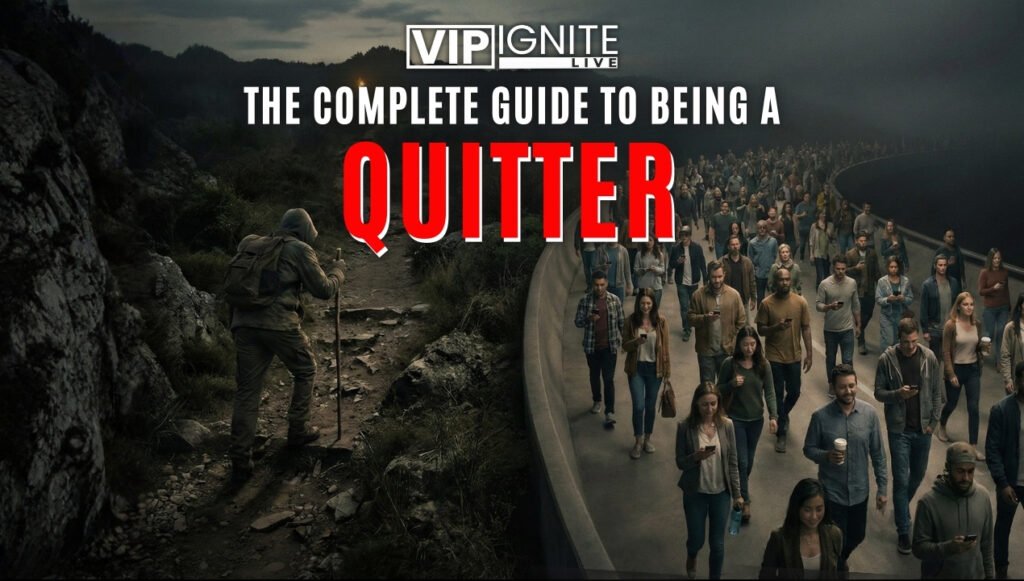
A Step-by-Step Manual for Giving Up Right Before It Works
By Sir Michael Fomkin
VIP Ignite Live
Let me start by congratulating you.
If you’re even thinking about quitting, you’re already ahead of the game—because quitting is one of the most popular hobbies in the world. Millions of people do it every day. It requires no certification, no discipline, and no follow-through. In fact, quitting is the most inclusive club on the planet. Everyone qualifies.
And today, as a public service, I want to give you the complete guide to being a quitter—so thorough, so accurate, so painfully honest, that by the end of this article… you’ll never want to quit again.
Because once you truly understand how quitting works, it becomes impossible to unsee what it steals from you.
So let’s begin.
Step 1: Decide That Discomfort Is a Sign You’re “Not Meant for This”
This is a classic move.
You feel uncomfortable. You feel awkward. You feel uncertain. And instead of recognizing those sensations as the universal symptoms of growth, you declare:
“I guess this just isn’t for me.”
Perfect. Flawless execution.
After all, if something doesn’t feel easy immediately, it must be wrong. Never mind that every meaningful skill—acting, modeling, entrepreneurship, leadership, confidence—feels unnatural at first. That’s irrelevant. What matters is that you expected mastery without friction.
Quitters are experts at confusing newness with incompatibility.
And the best part? You get to quit while still telling yourself a very comforting story:
“I’m just being realistic.”
Step 2: Compare Your Chapter One to Someone Else’s Chapter Twenty
Nothing fuels quitting faster than comparison.
Scroll social media. Look at people who have been doing this for ten, fifteen, twenty years. Ignore the failures, the rejections, the years nobody saw. Focus only on the highlight reel.
Then ask yourself, with genuine confusion:
“Why isn’t this happening for me yet?”
This is an elite quitter tactic. You take someone else’s finished house and compare it to your foundation, then conclude construction must be pointless.
At VIP Ignite Live, I’ve watched people stand inches away from opportunity—agents, producers, casting directors—and walk away because someone else looked further along.
Quitters don’t lose because they lack talent.
They lose because they refuse to be beginners.
Step 3: Romanticize the Exit
Every great quitter needs a compelling exit narrative.
You don’t just quit. You rebrand quitting.
You say things like:
-
- “I’m focusing on other priorities right now.”
- I just need to take a break.”
- “I’m trusting the universe to guide me.”
Translation: I’m uncomfortable being uncomfortable.
And look—there’s nothing wrong with rest. There’s nothing wrong with recalibration. But quitters don’t pause strategically. They disappear emotionally while pretending it’s temporary.
They don’t say, “I quit because I got scared.”
They say, “It just didn’t align.”
Alignment is a beautiful word. Quitters use it like camouflage.
Step 4: Quit Right Before the Inflection Point
This is the most tragic—and most common—mistake.
Quitting works best when you’re just about to break through.
You’ve invested time. You’ve invested money. You’ve invested energy. You’ve learned enough to finally be dangerous… and then you leave.
Why?
Because momentum feels chaotic right before it clarifies.
I’ve seen it for over two decades. Talent who were one conversation away, one audition away, one mindset shift away—gone.
Quitters never quit at the beginning when nothing is happening.
They quit when things start to get real.
Because real means responsibility. Real means visibility. Real means there’s no longer a clean excuse.

Step 5: Convince Yourself You’re “Saving Money”
Ah yes. The financial justification.
Quitters love this one.
They’ll spend money on distractions, comforts, and conveniences without blinking—but investing in themselves That’s suddenly irresponsible.
Here’s the irony: quitting is incredibly expensive.
You pay with:
-
- Years you don’t get back
- Opportunities you’ll never see again
- Confidence that erodes quietly
A future version of yourself that never arrives
But because none of that shows up on a bank statement, it feels invisible.
At VIP Ignite Live, I’ve watched people try to “save money” by quitting—only to spend the next ten years wondering what might have happened if they’d stayed in the room.
That curiosity tax is brutal.
Step 6: Blame the Industry (It’s a Fan Favorite)
When quitting, it’s important to assign blame externally.
Say things like:
-
- “The industry is rigged.”
- “It’s all about who you know.”
- “Only a few people make it.”
All of these statements contain a grain of truth—which is exactly why they’re so dangerous.
Yes, the industry is competitive.
Yes, relationships matter.
Yes, success is rare.
But here’s what quitters miss: rarity is the point.
If everyone could do it casually, it wouldn’t be valuable. The barrier is the filter. The pressure is the test.
The industry doesn’t reject quitters.
Quitters reject the process.
Step 7: Become the Cautionary Tale You Swore You’d Never Be
This part doesn’t happen immediately.
It happens quietly.
Years later, someone younger asks you about your dream—and you say:
“I tried that once.”
There’s no bitterness. Just a subtle resignation.
You speak like someone who survived something dangerous, rather than someone who walked away from something unfinished.
And the most painful part?
You’ll never know how close you were.
Because quitting doesn’t fail loudly.
It fails silently—over time.

Why I’m Writing This
I’ve been in this industry for over twenty years. I’ve watched talent rise, stall, disappear, and reappear. And I can tell you with absolute certainty:
The people who win aren’t the most talented.
They’re the most persistent.
They’re the ones who stayed when it stopped being exciting.
Who showed up when no one was watching.
Who didn’t quit when quitting felt logical.
At VIP Ignite Live, we don’t sell fantasies. We build stamina.
Because success doesn’t come from avoiding discomfort—it comes from outlasting it.
So Yes… Quit. (If You Want the Average Life)
Quit if you want comfort over growth.
Quit if you want certainty over possibility.
Quit if you want to be safe instead of significant.
But if there’s even a small voice inside you that knows you’re meant for more—
If you feel the pull, the tension, the frustration that says this matters—
Then don’t you dare quit.
Not because it’s easy.
But because it’s worth it.
And because the world already has enough quitters.
What it needs are people willing to stay.
—
Sir Michael Fomkin
VIP Ignite Live
Opening Doors. Elevating Careers. Changing Lives.
“It’s all about people skills and networking and that is what we offer.” – Alycia Kaback





Recent Comments